How To Build a Content Strategy That Delivers Measurable Results
There are too many gurus online who tell you that the answer to your lead generation problem is posting more content. It would be great if we could post content and watch the number in our bank account grow, but that’s not how it works.
Posting content for the sake of it and expecting results is like asking the same person out on a date every day but not sticking around to hear the answer.
It all comes down to strategy (I’m talking about content strategy now, not pick-up artistry). If you don’t have a solid content strategy which puts your ideal customer’s needs, wants, and desires first, you will be stuck in a constant cycle of investing time and resources into creating content that gets lost in the ocean of failed business content.
Content marketing can be comparable to investing in a savings account that returns 10% interest every year. The more consistently you invest, the higher your return. It compounds exponentially. That’s only if it’s done right, though. Content marketing done off a whim (or generated with AI) is like taking that money and burning it (or investing into NFTs in 2020).
Maybe you’re already stuck in that cycle and want out. Well, I’m here to offer a solution. I’m not going to lie to you and say it’s an easy one, though. If you want your content to generate leads, it’s going to take consistency and patience.
What is content marketing?
Content marketing is the practice of attracting customers by creating valuable content.
It’s different from traditional marketing, which usually relies on paid distribution in an attempt to interrupt your attention to push messages and promote products. Content marketing earns attention and pulls audiences in. It educates and entertains to build trust over time.
Take this article as an example. I could write, “I’m a marketer, give me money.” but instead I’m structuring my expertise into a (hopefully) helpful piece of content to help you achieve a specific goal. I’m here to genuinely help you.
“If you can get immediate sales with traditional marketing, why would you invest significant time and money into content marketing?” I get it. Content is cringy and is the longest of long games. But it’s worth it. Here’s why…
The birth of social media a few decades ago has changed the way we live as human beings. Scrolling on social media has become a staple of the morning routine for 5.79 billion social media users, and that brings a wealth of opportunities for marketers and entrepreneurs.
People make purchasing decisions differently from how they did 10 years ago, too. We have access to an endless library of information with 1,000s of companies selling a seemingly identical product. We research. compare options, and look for expertise before parting with our hard-earned cash.
Developing and implementing a solid content marketing strategy puts you ahead of your competitors and makes you stand out. Not to mention other benefits like:
Build trust with your ideal audience
Build authority in your industry
Generate quality leads
Retain your current customers
Improve SEO
Develop a community of people that champion your product or service
Buyers engage with content long before they engage with sales. And for businesses who don’t want to spend thousands on paid ads in the hope that people will convert straight away, content marketing offers a long-term approach.
But, if you don’t understand who your creating content for, it will fail.
Understanding your audience
The biggest mistake I made early in my career was assuming I understood customers without doing any research. Audience research is the most important part of any marketing strategy. If you don’t truly understand your audience, how can you possibly sell to them?
You should know the answer to these questions to understand your audience:
Who are they?
What are they trying to achieve?
What problems keep them awake at night?
What objections stop them buying?
What questions do they ask sales teams repeatedly?
These questions help you to create an ideal customer profile (ICP). This steers the majority of marketing decisions.
Ignoring this and trying to create content for everyone is a great way to waste time. Say you don’t who your ideal customer is, what they’re biggest pain points are, and how you can fix those pain points. So, you create content for “everyone”, and attract no one. Your audience don’t feel heard and nothing converts. If you’d been through that, you’ve probably already written off content marketing as something that just “doesn’t work” for you. But can you honestly say you have learnt everything you can about your audience?
The best way to package your understanding of your audience is to create a customer persona. A customer persona is composite sketch of a key segment of your audience. It includes some key details like:
Goals
Problems
Objections
Information sources
Buying triggers
How to create a marketing persona template by Content Marketing Institute.
When I first started in marketing, customer personas confused me. I thought, “How am I meant to narrow all the people I sell to to one persona?!” There are so many people that might be interested in my product or service, it’s impossible to boil it down to one persona.
But I missed the point.
Your customer persona doesn’t have to include every detail of everyone who’s ever bought your product. You don’t need to know what they had for breakfast, just the details we covered above.
Talking directly to one hypothetical person makes your content personal. It makes the people who need your product feel heard. They trust you more as a result of that.
Sourcing these insights can be easy if you already have a strong CRM with the nuggets of data hidden away, but if not, then there are still great ways to get to know your customers:
Customer interviews
Sales calls
Customer support tickets
Online communities
Search data
Industry events
Great. You now know the basics of content marketing and how to understand your audience. Next, we’ll talk about how to use this newfound knowledge to create the content that turns impressions into money.
Build a content ecosystem
One of the biggest reasons businesses struggle with content marketing is because they treat every piece of content as a separate project.
This creates two problems:
Content creation becomes time-consuming
Your best ideas disappear after a single use
You can start from scratch every time, or you can make your life 100x easier by building a content ecosystem.
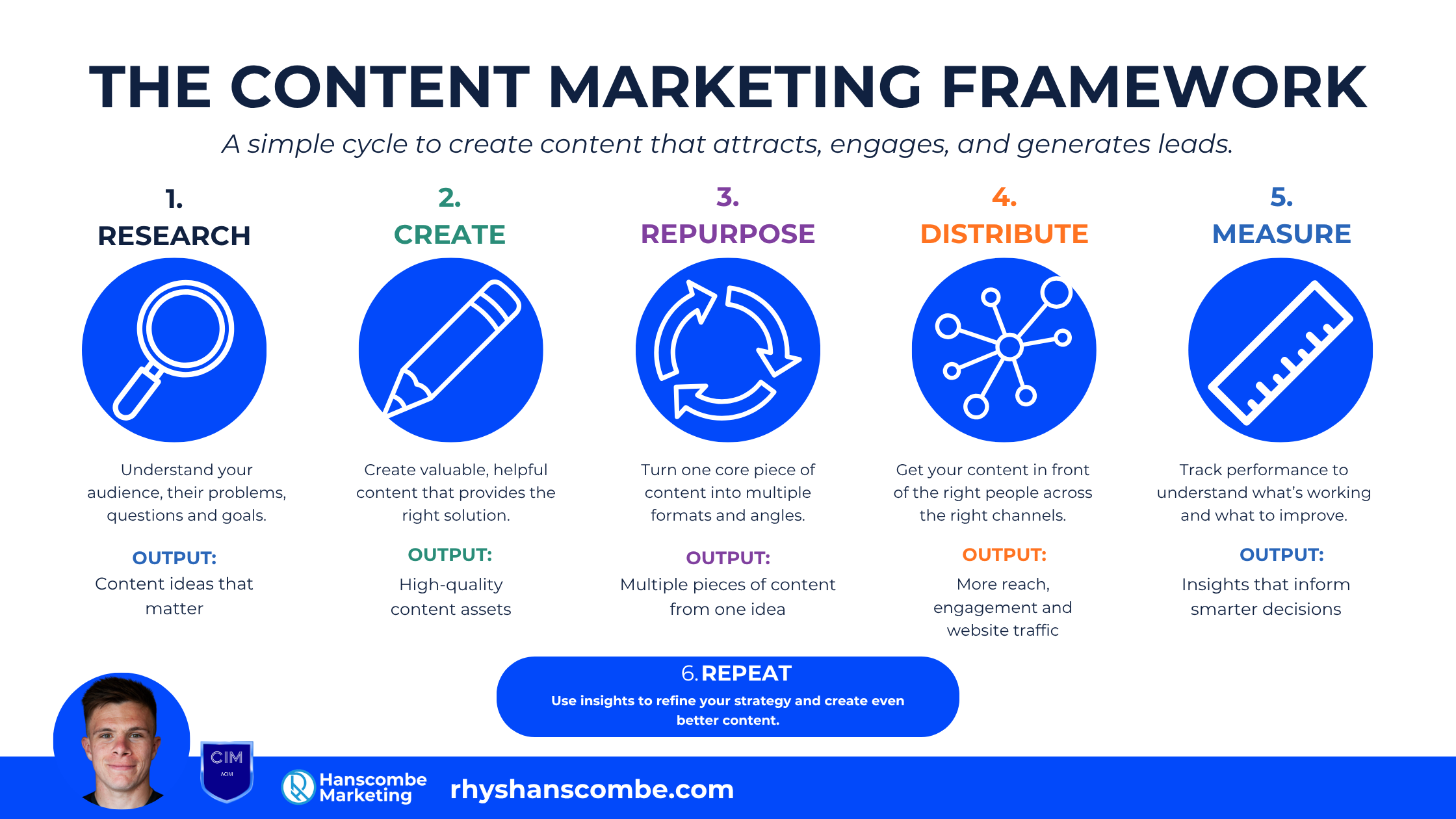
Instead of creating dozens of unrelated pieces of content, you start with one strong idea and adapt it into multiple formats across different channels.
Here’s what that might look like for you:
Research a topic that resonates with your audience.
Write a long-form article exploring that topic.
Turn the article into a YouTube video.
Create short-form clips of key moments from the video for YouTube Shorts, Instagram, and TikTok.
Go back to the article and take snippets from it to write short-form written content for LinkedIn, Facebook and X.
Create visual assets such as infographics, diagrams, or carousels.
Use the content to answer customer questions you hear every day.
Repeat.
Assuming that you can get at least 5 short-form pieces of content from both long-form formats, that one idea has turned into 35+ pieces of content across all channels. This is particularly relevant for small businesses with limited resources.
You don’t need to think of a new idea every day. The best businesses using content marketing focus on 3-5 key topics and repeat the same message, but package them in different ways.
Sticking to one piece of content on a topic dramatically reduces your chances of resonating with your ICP. Some people prefer reading. Others prefer watching videos. Some only engage with short-form content.
Who’s creating all this content, anyway?
Content marketing is an ongoing operation, and therefore, implementing a content marketing strategy needs to be properly managed. The process must clearly detail who must do what and when, as well as the technology required to support the delivery of content.
In an ideal world, you’d have a team of marketing geniuses with individual expertise in copywriting, graphic design, video producing & editing, social media management, and so on. For most in-house teams, however, this just isn’t possible. You’re not going to be able to replicate the same results with a smaller team.
Consistency is the most important skill
A single article won’t transform your business. A single LinkedIn post won’t generate hundreds of leads. But publishing valuable content consistently for months or years creates an asset that compounds over time.
Every piece of content becomes another entry point to your business, and another opportunity to build trust.
Content marketing is less like advertising - where you shoot for high reach one time - and more like investing.
Content distribution
If nobody sees your content, it doesn’t matter how good it is. Spending hours on content just to publish it and never think of it again is like writing a book and leaving it in a drawer.
The best content marketers spend as much time distributing content as they do creating it.
This can mean:
Sharing content across multiple social media platforms
Sending content to your email list
Sharing content in relevant communities
Responding to comments and engaging with similar content
Referencing content during sales conversations
Linking related content together on your website
It really is all part of an ecosystem or machine.
Your content should support the entire customer journey
Most businesses only create content that gets their brand seen by as many people as possible. That’s great, but it probably isn’t converting that awareness into purchases. It’s a waste of resources if you want to make money. You don’t need the world to see your content to see results from your content. You need the right people to see your content at every stage of the customer journey.
They might need to be made aware of the problem you solve first. Or they might know their problem and need to know that you can be trusted to deliver a reliable solution. Regardless, a stronger strategy supports every stage of the customer journey
5 stages of your customers’ buying journey
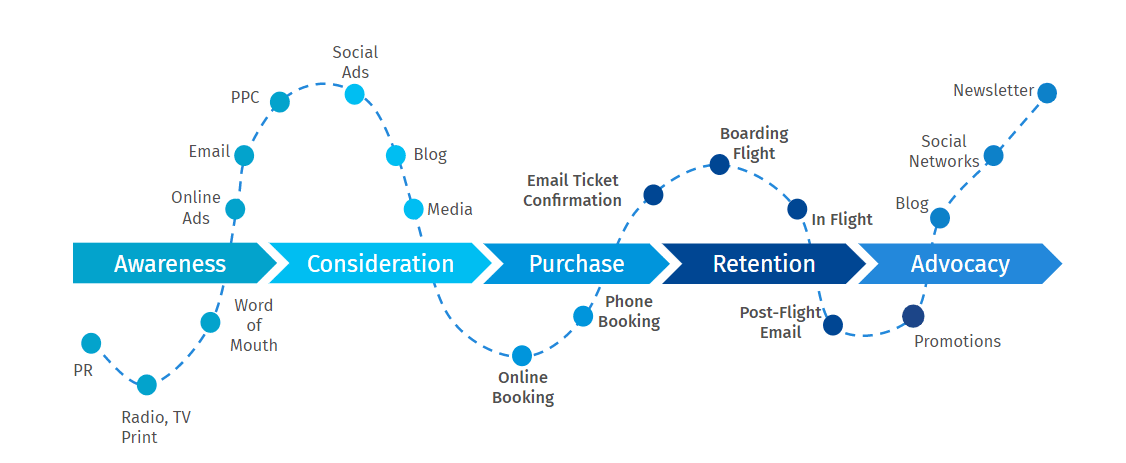
Effective Customer Journey Guide with Examples + Free Templates
There are 5 stages of a customer buyer journey as shown in the image above. Only the first three stages are relevant in a content marketing context.
Here’s a summary of each stage and some examples of the type of content you might use to appeal to customers at each one.
Awareness
Help people understand a problem.
Examples:
Blogs
Social content
Videos
Consideration
Help people evaluate solutions
Examples:
Guides
Case studies
Webinars
Purchase
Help people choose.
Examples:
Testimonials
Product comparisons
Demonstrations
What does success look like to you?
A successful content marketing strategy largely depends on you. Success looks different for every business, so you need to work out what it looks like for your business.
It can be easy to get caught up in vanity metrics like impressions, likes, and followers, but that isn’t really delivering value to the business.
In my opinion, marketing should be commercially-focused. So, metrics like qualified leads from content, email subscribers, and demo bookings could be better indicators of a successful content marketing strategy.
Using AI to create content
AI has lowered the barrier to creating content. It has not lowered the barrier to creating useful content. The businesses winning with AI aren’t replacing human expertise; they’re amplifying it. AI can help you research, draft and repurpose content. It can’t develop a point of view, build trust, or replace real-world experience.
Scroll on any social media platform for 10 minutes, and you’ll find a long list of content that looks the same and says the same as all the others.
Content is becoming the first thing businesses create with the development of AI models like ChatGPT and Claude. They think they’re getting ahead of everyone else because they’re automating the marketing work. But they’re forgetting the fact that everyone else is doing and thinking the same thing. Now, it looks like every company in the world that undervalues marketing is using the same graphic designer, copywriter, and content strategist to create content. They are, and that’s why it’s a problem. It might seem like it’s working now because this is new and people are still falling for AI-generated content, but people buy from people. If you create content solely using AI, you will fall behind.
There’s no doubt that AI makes content creation easier. It doesn’t make content strategy with real human input less important, though.
AI can help with research, ideation, drafting, and repurposing. But it cannot replace strategy, audience understanding, original experience, and subject matter expertise.
You are one of one - an expert in your field. Make sure the world knows about it.
Don’t forget the CTA
Content without a call-to-action (CTA) is often wasted.
You’ve earned someone’s attention. You’ve invested time into helping them solve a problem. Now what do you want them to do next?
Download a white paper, guide, or ebook? Attend a webinar? Complete a scorecard?
The purpose of a CTA is to move someone one step further along their buying journey. Without it, we’re just creating content to build our egos.
Too many businesses share content and hope people magically know what to do next. If your CTA isn’t completely obvious, it will be missed. It should tell the consumer exactly what they get from taking action and why they should do it.
So, to prove that point, here’s mine.
This article is part of my content strategy. To give full transparency, it’s also the final module of my marketing diploma. So I thought that the best way to cement my knowledge in preparation for my assessment was to write an article on it.
If you’re trying to improve your own content marketing and want to read more articles like this on marketing, personal branding, and business growth, subscribe to my newsletter below.
Your content becomes your intellectual capital. No one can say exactly what you have to say. There’s no avoiding the fact that the internet is full of different opinions about everything. You might think that it’s too saturated already and that you have nothing to add. But the future of your business might depend on you developing a content marketing strategy.
Content marketing isn’t about posting more. It’s about understanding your audience, creating content that helps them make decisions, and consistently showing up where they already spend their time.
It’s an asset that compounds over time.
Build a content strategy first, then the day-to-day creation of content becomes much easier, and your bank account grows.