The Essentials of Karting Fitness
Karting is extremely physical. Unlike other categories, you’re often doing laps under 60s with few opportunities to relax. You’re not harnessed into your seat, so your body takes the beating from every corner, kerb, and contact. Add onto that the fact that there’s no suspension to absorb the impact of the road, and it becomes difficult to maintain high performance for longer than 10 minutes.
Unfortunately, some kart drivers neglect the physical and mental preparation part of the sport.
They think that training and nutrition is irrelevant for karting athletes. All they need to do is turn up on race day and compete. This might work for drivers who are racing as a hobby, but if you want a long career in motorsport, you need to train your body and mind. This is so that you’re able to drive consistently quick throughout the entire race weekend.
Your competitors who are serious about a career in karting and motorsport are committing significant time and energy to preparing for racing so they can beat you.
What are you doing to beat them?
Why Take My Advice?
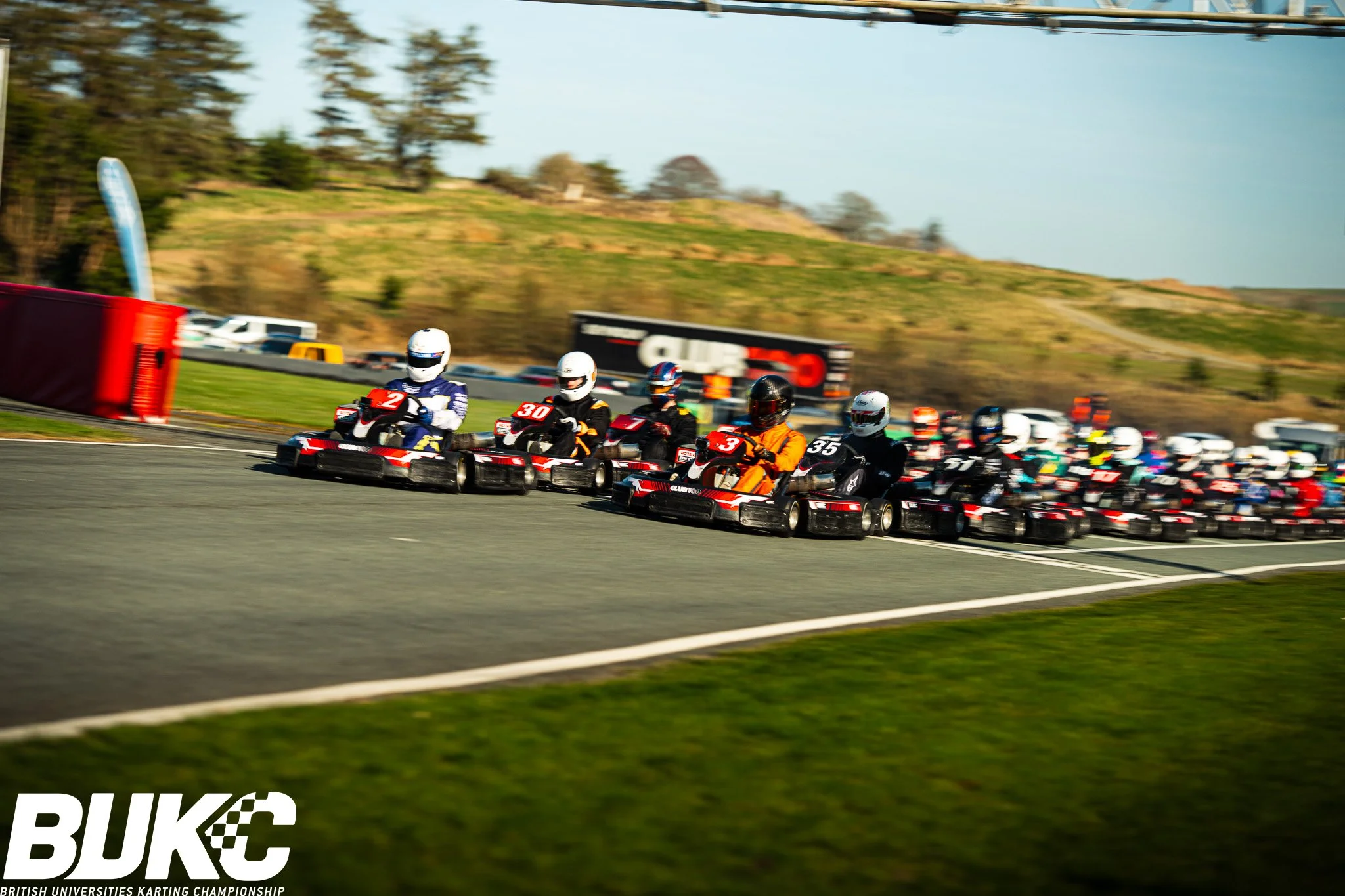
Me karting in BUKC (number 30).
Who’s this random guy writing on the internet telling you that fitness for karting is important, anyway?
Well, I’m not claiming that I’m a veteran of the sport who “could’ve” gone to F1 if it wasn’t for blah blah blah…
But I’ve been competing in owner-karting races since 2022. I spend 3-4 hours on the track time each race weekend (including 2 x 1.5-hour races).
When I first started, I was the kart driver who neglected the preparation part of the sport. I turned up, raced, then ached and felt tired for the next few days.
Since 2020, I’ve studied sport and exercise science, with a focus on motorsport. I found that sports science for racing drivers isn’t accessible unless you’re at the pinnacle of the sport, so I created this platform to make it easy for drivers like you to enjoy your racing and perform at your best.
Areas to focus on
You don’t need to overcomplicate fitness for karting. After all, we all would rather be out on track racing, won’t we?
But there are some key areas of fitness that you should focus on to prepare your body and mind for karting.
Neck Strength for Karting
Your neck takes the majority of the g-forces when you turn, accelerate, and brake. Typically pulling 2g of g-force (or 2 times your body weight), your neck needs to be able to withstand the g-forces from turning, accelerating, and braking. These are typically 2g of force (or 2x your body weight). When you add that up over a sprint or endurance race, that’s a lot of weight being channelled through your neck muscles to keep your head on straight.
Head stability is key. If your succumbing to the g-forces throughout a stint, you’re losing focus on the track.
Here are some easy ways to work on your neck strength without the need for high-cost equipment:
Put helmet on and lay off the edge of a flat surface (your bed) and do neck raises
Neck raises
Neck bridge
Core Strength for Karting
Core strength is another important part of karting fitness. Being able to control your core - and your entire body - throughout a race will delay any performance declines from fatigue you might face. Controlling your breathing is also an element of this. But we’ll touch on cardiovascular fitness later.
Here’s how to improve core strength for karting:
Sit ups
Planks
Hanging leg raise
Forearm Strength for Karting
Your ability to maintain a strong grip on the steering wheel is one of the final layers that determines whether you’re hitting the apex consistently throughout the race or not.
Here’s some ways to improve forearm strength for karting:
Pull up
Zottman curl
Farmer carries with kettlebells
Cardiovascular Fitness for Karting
If you take ONE thing from this article, let it be cardiovascular fitness.
Improving cardiovascular fitness for karting can be achieved through any activity that raises your heart rate to a moderate amount. My favourite is running, but you could also try swimming or cycling. Whatever you enjoy most is the best.
It’s important to strengthen these areas through training, but it isn’t the whole package. You need to consider the impact of nutrition and recovery.
Training is Useless without Proper Nutrition
To train properly, you need to fuel your body (just like a kart) appropriately. Just like your kart, you can’t function properly without the right fuel. I don’t suggest drinking a gallon of 2-stroke before your next training session, though.
Again, you don’t need to overcomplicate this, either.
You’ll see a lot of coaches online pushing a certain diet or nutrition strategy, but the principles are simple:
Stay hydrated
Eat cleanly (try to avoid unprocessed foods)
Consume enough calories to fuel your training sessions (I usually burn 600-800 calories per 90-minute race)
Replenish the calories you burn after each training or karting session
Understand that sugar is good for energy replenishment
Rest and Recovery
First of all, it’s important to understand that there is no “right” way of resting and recovering. How you recover is individual to you. You might find true relaxation in binge-watching a TV series in the evenings. Or the thought of that stresses you out. Maybe you find relaxation in seeing friends and family. Whatever it is, you need to make time for it to get the most out of your training for karting. Not just so you can perform at your best on race day, but also so you don’t burnout from making karting your entire personality.
Cross-Training
Valtteri Bottas’ Strava profile.
Valterri Bottas cycles ~100 miles per week.
Lando Norris and Carlos Sainz famously play golf and padel.
Fernando Alonso owned a cycling team.
Max Verstappen drives everything.
There’s a pattern in Formula 1 drivers that you can use to become a better kart driver, and eventually a racing driver in Formula or sports cars. That is cross-training.
As I mentioned, motorsport isn’t easily accessible. You can’t spend hours directly practicing the sport every day like you can with other sports like football or basketball. But you can use skills and fitness from other sports and translate that to faster lap times.
Nothing Beats Racing
Of course, the best way to train for karting is to drive a kart. But we don’t always have access to unlimited kart and track time. Even with the development of sim racing in the past decade, nothing beats time in the seat.